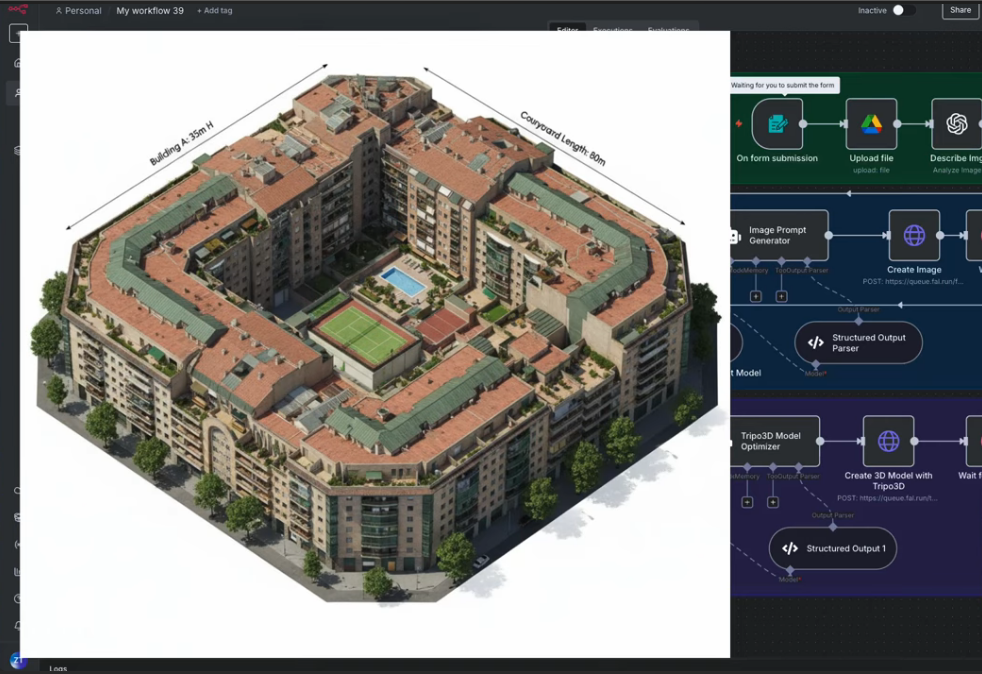
If you haven't seen it yet, Zubair Trabzada's recent walkthrough on using NanoBanana and n8n for 3D model automation is worth a watch. With a few lines of text or a simple screenshot, you can now generate fully rendered 3D concepts and even push them into modeling APIs like Tripo3D for complete geometry creation.
At Matechi, we've been exploring how this same logic can be extended into BIM and architectural workflows - where automation doesn't just create a pretty render, but builds something intelligent, editable, and project-ready.
The Idea
Imagine starting with any input: a sketch, a product image, or a detailed spec sheet. An AI agent interprets the materials, dimensions, and functional intent, then refines that understanding through a reasoning layer that maps everything to the correct BIM category.
From there, another agent calls geometry-generation models like NanoBanana or Hunyuan3D to produce a detailed mesh. A secondary process converts that mesh into a clean, Revit-compatible solid, while the system automatically assigns parameters, types, and even materials.
In short: describe it, and it becomes a Revit family. Add a few sentences about its behavior, and it becomes parametric.
How It Could Work (Conceptually)
- Input Layer - Text, image, or spec file is analyzed through a vision-language model that extracts structured attributes.
- Reasoning Layer - AI determines what kind of object it is, what category it belongs to, and what parameters it should carry.
- Generation Layer - A 3D model is created through NanoBanana, Tripo3D, or similar APIs.
- Conversion & Assembly Layer - The geometry is cleaned and imported into a Revit Family Editor via Forge or a Revit API connector.
- Validation Layer - The user can review, adjust, and regenerate until the result matches their intent.
Why It Matters
Architects, engineers, and manufacturers spend countless hours creating or cleaning up content libraries. By enabling AI to understand, generate, and standardize these assets, we shift BIM authoring from a manual exercise to an intelligent, assisted process.
It's not about replacing design work - it's about eliminating the repetitive, technical bottlenecks that slow innovation.