Inputs, outputs, integrations, and control boundaries.
This public documentation index explains what each Matechi product consumes, what it returns, where users review evidence, and which decisions remain with the client team.
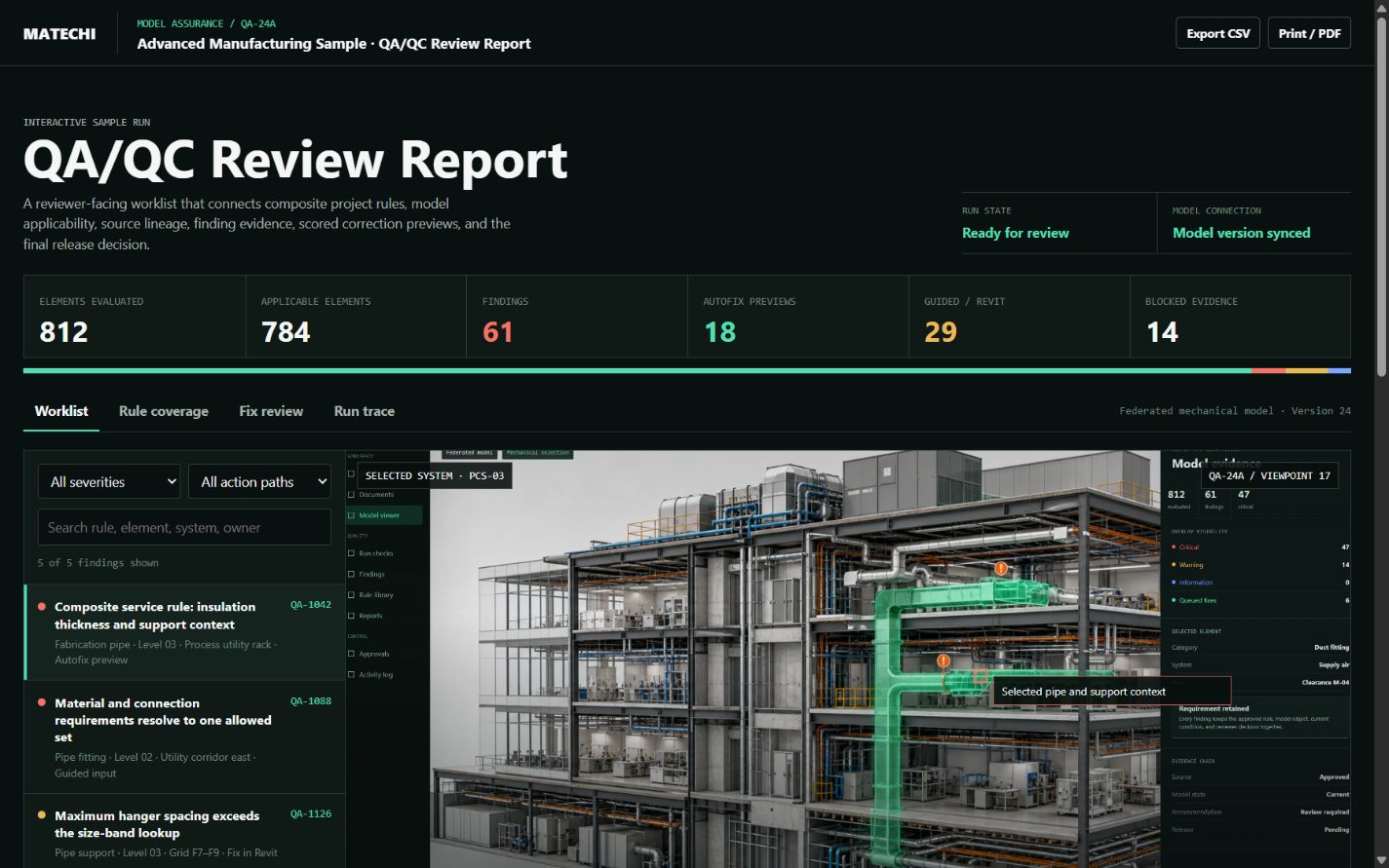
QA/QC Agent
Inputs: Revit model data, approved standards, specifications, and rule packs. Outputs: cited findings, element links, applicability context, autofix previews, review decisions, and run reports. Reviewer authority governs every consequential correction.
Clash Detection Agent
Inputs: current and linked models, clash tests, clearance rules, system priorities, and discipline ownership. Outputs: prioritized conflicts, selected 3D evidence, constrained resolution options, fix queues, issue context, and RFI paths.
Platform and integration layer
Approved documents, Revit and ACC context, shared rules and specifications, reviewed actions, Stratus fabrication data, reports, analytics, feedback, confidence controls, approvals, and version history can remain connected around the same decision record. Integration depth follows the client's permissions and agreed action boundary.
Modular Configurator
The house builder edits source-bound geometry in linked plan and 3D views, with component counts, study datums, drawings and exports. The separate Registry example carries exact product and interface versions plus scoped pass, fail or indeterminate receipts between Logic and Matechi. Source-house product identities, connection definitions and real prices remain pending. The public reference does not approve fabrication or engineering.
Factory Designer and Pod Traveler
Factory Designer exposes labeled equipment, station footprints, routes, plan views and assumption-based production scenarios. Its synthetic layout is not a safety or capacity approval. Pod Traveler retains unit-level hold points, quality evidence, issues, custody, delivery, installation and closeout status.
Revit Content Creator and Enablement
Content Creator develops and validates parametric family output from product information. Enablement OS compares candidate agents by value, evidence, access, exceptions, reversibility, and authority.