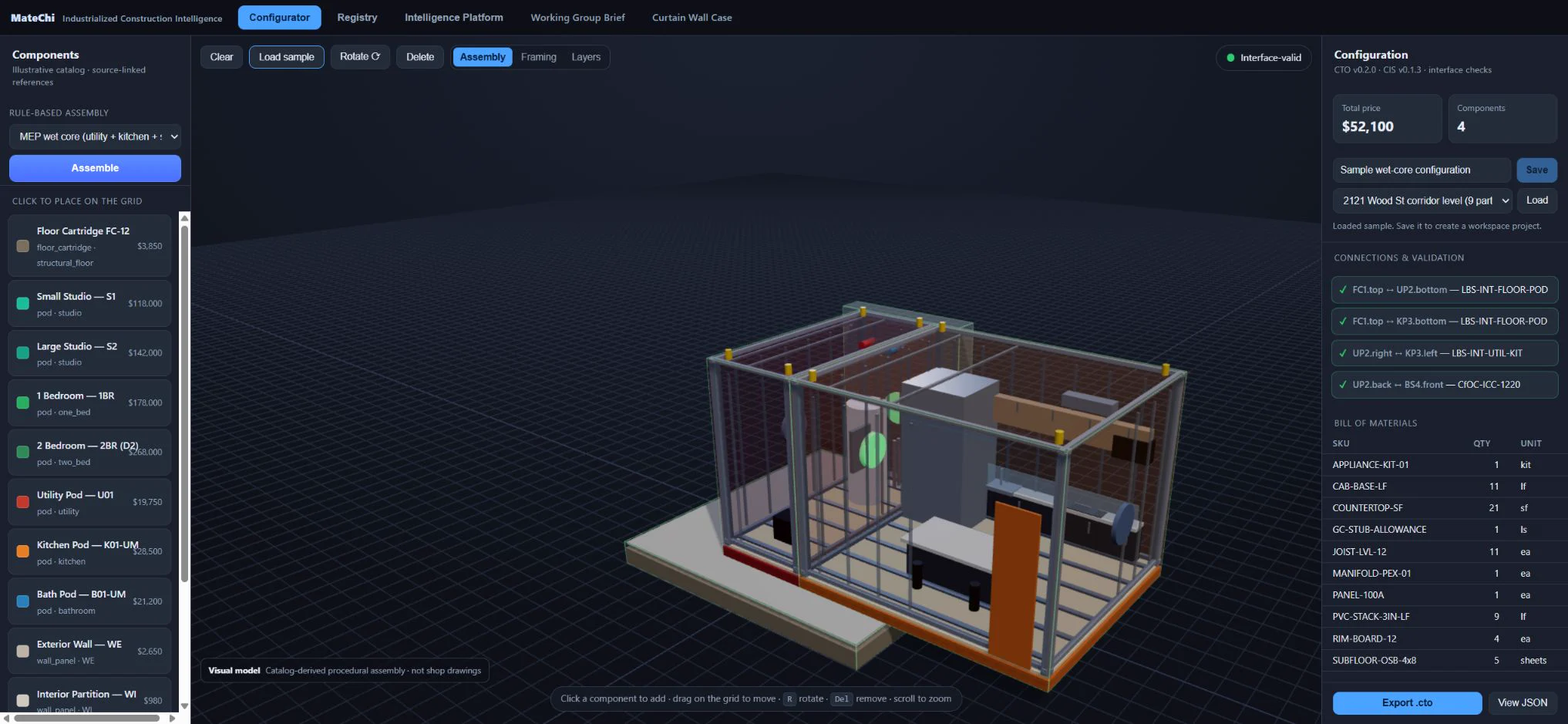
A modular configurator should not behave like an unconstrained design generator. Its job is to expose a useful product space that engineering, manufacturing, and commercial teams have already agreed can be delivered.
That makes configure-to-order different from both a static catalog and engineer-to-order work. The customer or sales team can choose meaningful options, but every available combination remains inside approved product, interface, pricing, and production rules.
The Catalog Must Carry Behavior
A component record needs more than a name and image. It may carry geometry, dimensional ranges, interface types, compatible neighbors, required companions, excluded combinations, service zones, structural limits, materials, finishes, costs, lead times, lifecycle status, and identifiers used downstream.
For a bathroom pod, that may include structural frame, wall and floor assemblies, fixtures, access zones, plumbing and electrical connections, finish packages, door orientation, and type-specific constraints. For a facade cassette or service module, the vocabulary changes but the principle remains: every option needs machine-readable relationships.
Interfaces Are the Product Logic
Most invalid configurations fail at interfaces. Two components may fit visually while disagreeing on connection type, clearance, load path, service alignment, fire or acoustic requirement, or the production sequence needed to assemble them.
- Connection identity and compatible counterpart.
- Position, orientation, tolerance, and allowable adjustment.
- Required clearances and maintenance access.
- Structural, envelope, and service constraints.
- Required hardware, seals, adapters, or companion components.
- Inspection or approval required before the interface can be released.
A good configurator validates those conditions as the user works. It blocks impossible combinations, explains the rule, and suggests approved alternatives rather than waiting for engineering to discover the problem after a quote or design commitment.
Keep Commercial and Production Output Synchronized
Every accepted change should update the relevant commercial and production record. That can include price, bill of materials, product code, weight, lead time, assembly instructions, interface record, and the identifiers used by ERP, production planning, quality, logistics, and field installation.
Open standards can help maintain that thread. buildingSMART describes Industry Foundation Classes as an open international standard for BIM data exchange, while its Information Delivery Specification provides a machine-readable way to define information requirements. Those standards do not replace a manufacturer's product rules, but they can support interoperable identities and validation at handoffs.
Use Configuration State as a Digital Thread
The saved configuration should remain identifiable after the sales session. Design should know which approved option set it represents. Manufacturing should know which revision and BOM to build. Quality should know which checks apply. The traveler should know which physical unit carries that configuration. Field teams should know which interfaces and installation evidence belong to it.
That continuity is where the configurator becomes more than a sales tool. It establishes a product decision that downstream systems can consume without repeatedly translating the customer's intent.
Pilot One Product Family
The first implementation should be narrow enough to verify. Choose one repeatable pod, panel, module, or kit with a meaningful but manageable option range. Build the catalog and interface rules, test valid and invalid combinations, compare price and BOM output against the current process, and trace one saved configuration into the next system.
- Option coverage: can users express the configurations the business actually sells?
- Rule accuracy: are invalid combinations blocked for the right reason?
- Output accuracy: do price, BOM, identifiers, and connection records match approved references?
- Decision time: does the team reach a validated configuration faster?
- Handoff quality: can downstream users consume the result without rebuilding it?
Matechi's Modular Configurator applies this approach to bathroom and kitchen pods, wall and facade systems, services, and other approved assemblies. The interface combines a 3D configuration, component catalog, validation, live price, and bill of materials while engineering retains control of the rules. Explore the configurator.