What an AI Revit QA/QC system should prove.
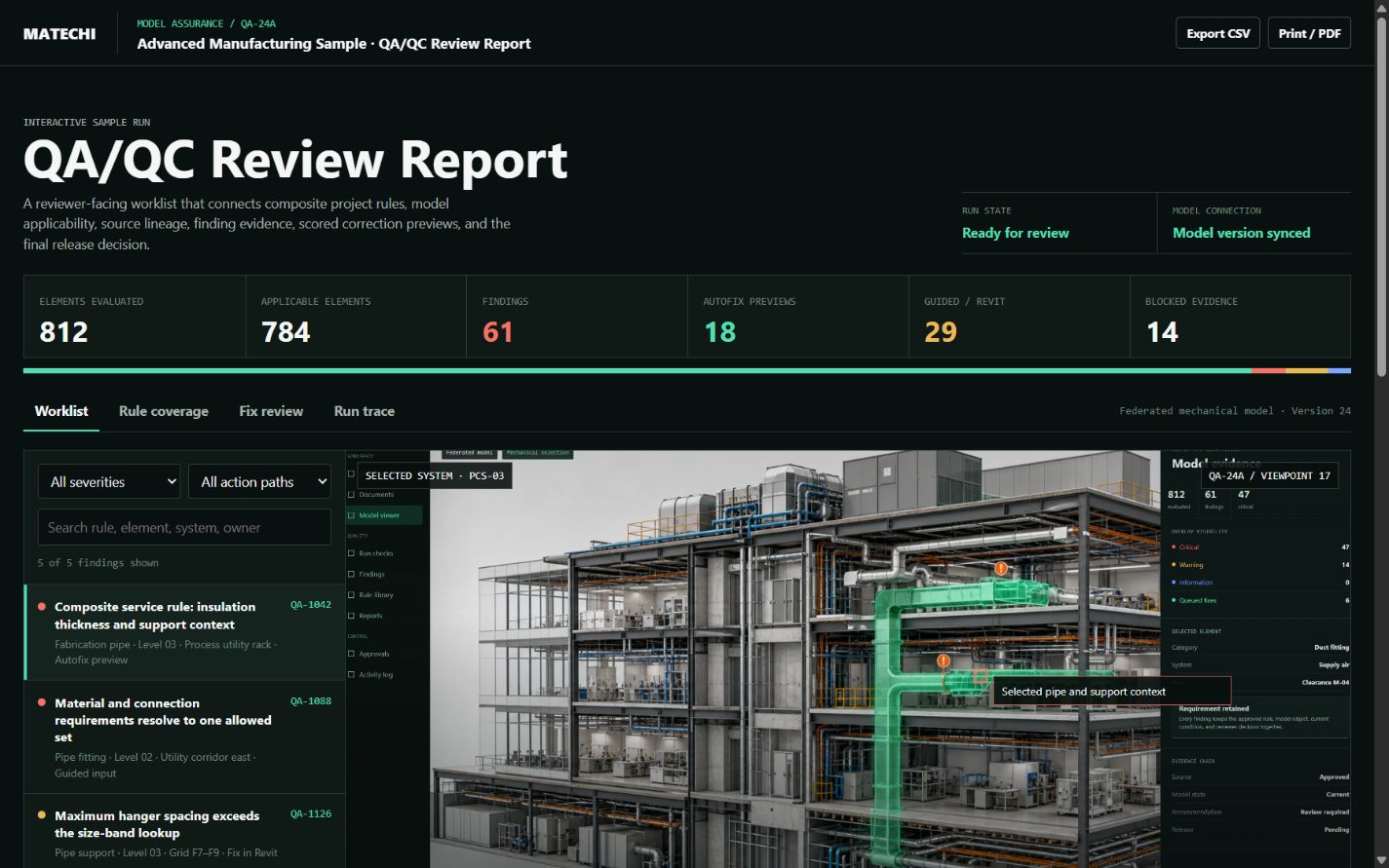
A useful system must do more than flag model data. It should show why a requirement applies, cite the source, preserve element evidence, separate deterministic checks from judgment, and keep correction authority visible.
Requirements and applicability
Ask whether rules carry scope, exceptions, project overrides, and citations. A global checklist applied to every element creates noise and weakens trust.
Finding evidence
Each result should identify the evaluated element, current value or condition, expected requirement, source clause, model context, severity, and reason the rule applied.
Correction and review
Autofix should mean a bounded, reversible, previewed action under named approval. Other conditions should route clearly to Revit, coordination, deferral, acceptance, or another owner.
Evaluation questions
Measure useful findings, false positives, missed conditions, review time, accepted corrections, reversibility, and operator confidence on representative work. Do not treat total findings as the success metric.